I want to share a cute story about why we will never have nanoscopic submarines floating around inside us. This post is inspired by a quote from Feynman’s famous speech titled “There’s plenty of room at the bottom”.
A friend of mine (Albert R. Hibbs) suggests a very interesting possibility
for relatively small machines. He says that, although it is a very wild idea,
it would be interesting in surgery if you could swallow the surgeon. You put
the mechanical surgeon inside the blood vessel and it goes into the heart and
“looks” around. (Of course the information has to be fed out.) It finds out which valve is the faulty one and takes a little knife and slices it out. Other small machines might be permanently incorporated in the body to assist some inadequately-functioning organ.– Richard Feynman (1959)
It’s unlikely that Feynman’s friend was the first person to suggest we “swallow the surgeon”, but they were definitely not the last! An article published by CNN in
2005 claimed that human immortality is no more than 20 years away (!), thanks
to the development of surgical “nanobots”. Unfortunately the science has not kept up with the hype. It is highly unlikely that nanobots, as portrayed by Feynman, will ever be swimming inside us.

Shrinking existing technology is not enough to create nanobots. You quickly run into problems with scaling effects; changing the size of objects by large factors changes the properties of those objects. Classical scaling effects pose a considerable problem long before you enters the quantum regime. In particular, fluid mechanics spoils the fun!
Let’s imagine our nanobot as a submarine scaled down to the size of a red blood cell. Ignoring all mechanical difficulties (e.g. cold welding/ intermolecular attraction of the gears), the engines of our nanobot supply a driving force 


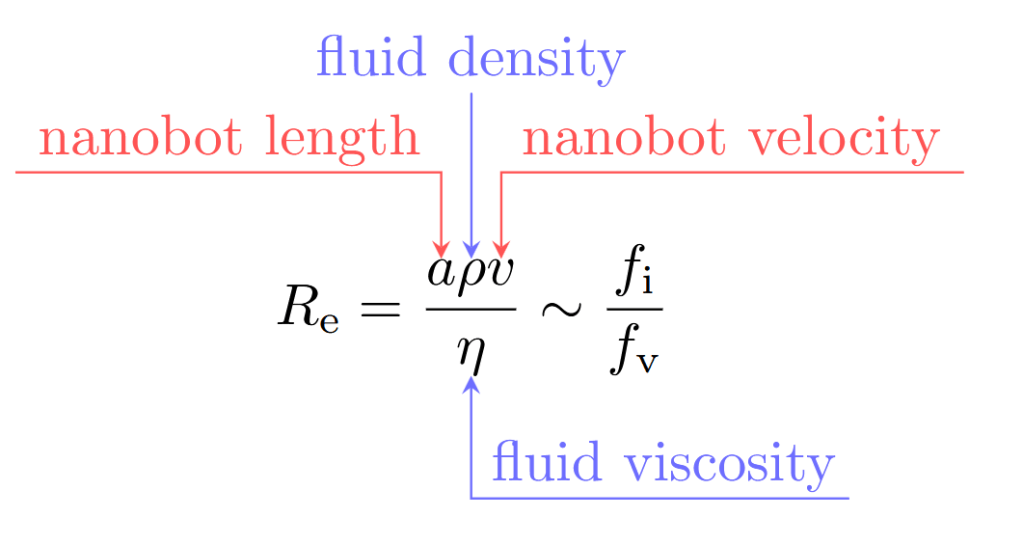
This simple equation highlights the problem. At lower Reynolds numbers, viscosity 


Will the nanobot be able to swim? Consider the force per unit mass 
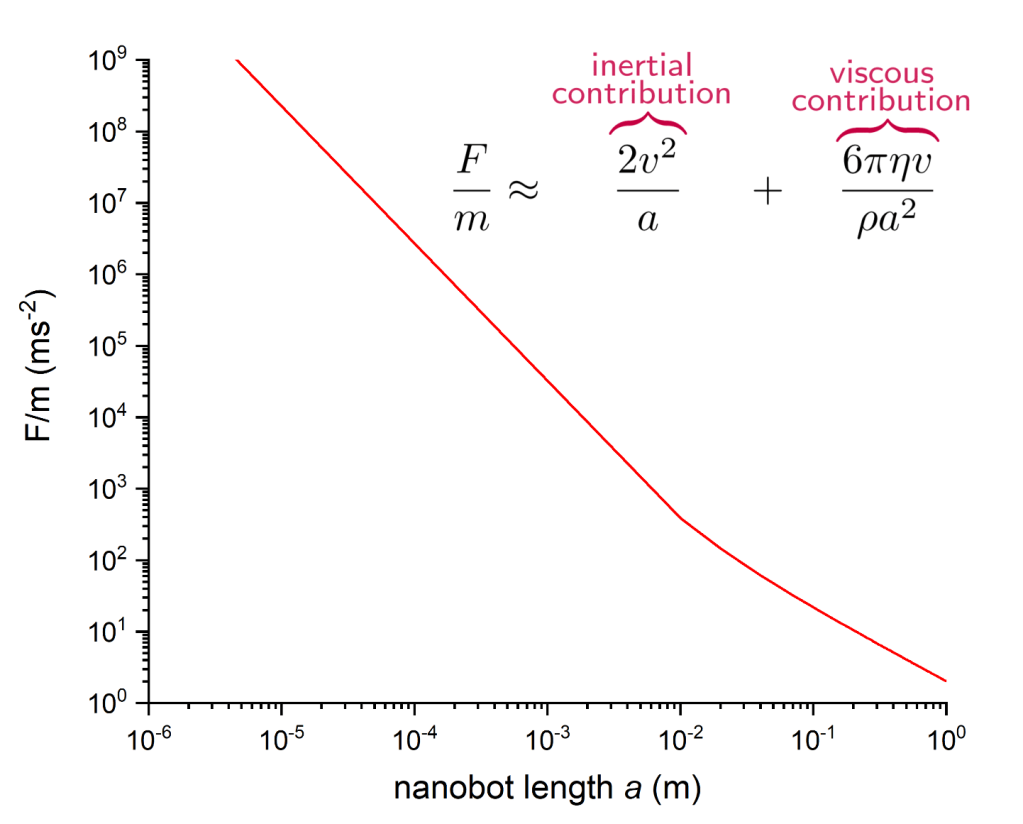
values chosen;
 ,
,  , density and viscosity of water.
The fluid resistance grows exponentially as the submarine gets smaller! Nanobots would need much advanced propulsion systems then our most efficient technology. For example, NASA’s Space Shuttle only had an 
 Patrick O'Brien
Leave a comment